A Talk With Ni Petrov About [ŚŪ]
A closer look at Ni Petrov's latest collection, *ŚŪ*, exploring human movement, anonymity and disconnection through AI-generated video, monochrome imagery and the Buddhist concept of emptiness.
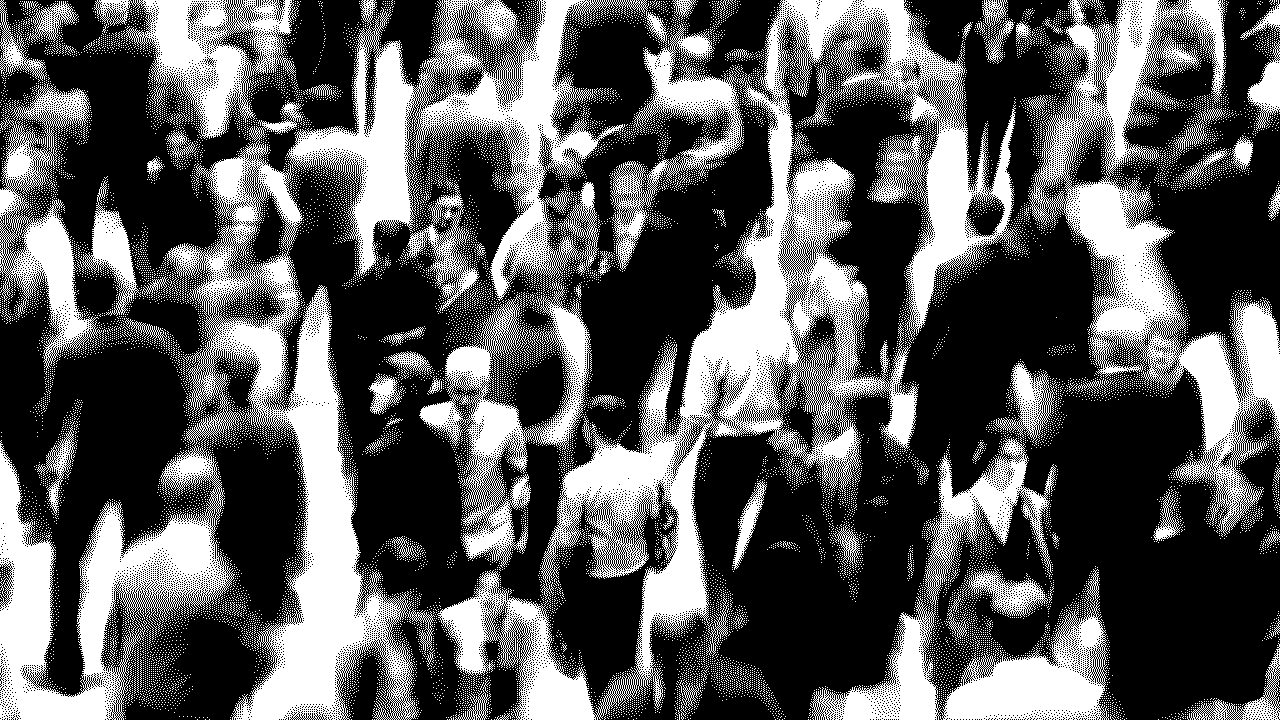
reated by Ni Petrov, the series explores human movement, crowds and our place within an increasingly connected world. Working with AI-generated video, Ni strips away colour and background detail, leaving behind monochrome figures that dissolve, distort and move through empty space.
What we find particularly interesting is how something so visually minimal can communicate so much. As someone who lives in a busy city and often gets caught up in the so-called rat race of life, I find the way these works explore the relationship between people, individuality and disconnection really interesting.
Inspired by the Buddhist concept of śūnyatā, the collection explores emptiness and the idea that everything exists in relation to something else.
We spoke with Ni about the inspiration behind ŚŪ, his fascination with human movement, the process of creating the collection and the ideas that sit behind it.

Ni Petrov, [ŚŪ] #7, 2026
What first inspired the concept behind ŚŪ, and how did the collection come together?
It all started with a long period of studying how generative algorithms work, and more importantly, with the desire to find something that does not yet exist in the usual photographic sense. I was looking for a way to move away from capturing what is already there and toward creating what becomes possible only in the process itself. The collection took shape gradually. Early experiments were mostly about testing the limits of the tools, and over time certain visual and conceptual directions began to emerge on their own. What remained was the tension between presence and absence: figures that feel familiar but have no original.
Your work often explores crowds and human movement. What draws you to these subjects?
It is hard to name one specific reason. For a long time I photographed cities and architecture, and at some point the focus shifted to people. What interests me is not so much the individual as the way bodies occupy space and move through it, the patterns that appear when many people are together, the temporary structures they create without intending to. When I later remove the background in the editor, the process becomes almost meditative. The figures are isolated, the noise falls away, and what remains is a kind of pure gesture or presence. This clearing of space is as important to me as the shooting itself.

Ni Petrov, [ŚŪ] #64, 2026
You spent years photographing real people. In ŚŪ nobody in the work has ever existed. How did you get from one to the other?
I still continue to photograph, and a lot of material has accumulated for processing. The prompt for creating the ŚŪ series grew out of the description of the project with people; one flowed into the other.
When generating hundreds of videos for ŚŪ, how did you decide which ones were worth keeping?
The selection of what to keep was based on composition and mood. From hundreds of generations I chose those that had the right density, rhythm, or, on the contrary, emptiness, the ones that resonated with the overall feeling of the series.

Ni Petrov, [ŚŪ] #73, 2026
What made you choose to work in monochrome?
I wanted to move away from color and toward minimalism. Black and white allows me to focus on form, movement, and the space between figures, removing everything unnecessary.
What does the concept of śūnyatā mean to you, and how does it connect to the collection?
The name śūnyatā appeared later. I was looking for some definition for the collection. In general I do not like naming my works, because it immediately limits perception. But here I liked the idea itself: the striving toward emptiness, the departure from the visual. For me this is connected with an attempt to approach a state where the image almost disappears, leaving only a trace of presence.
You can find Ni Petrov’s work on Verse, SuperRare and Objkt. Follow him on Instagram and X at @nipetrov.